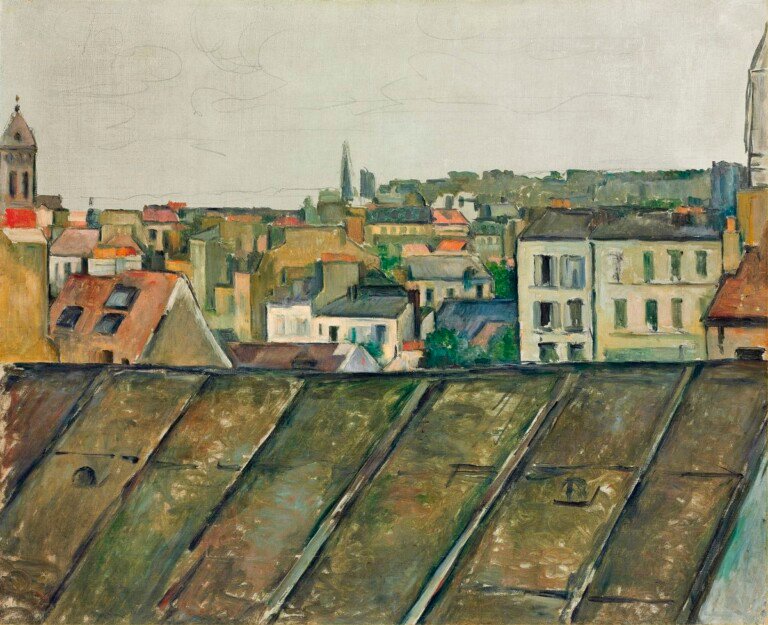
Frank Cierpial, a Paris tour guide, explores how artistic taste is formed, with an underlying question — why did Monet become famous while Cézanne remained overlooked?
Before I knew anything about art, I had heard the name Claude Monet. As a tourism professional and a guide, I am very interested in what motivates clients to make certain choices. I wasn’t always working in hospitality, and I often use myself as an example. I tried to go back into my memory and think of when was the first time I heard Monet’s name. On one of my last trips to the US, I came to the realization that it could have been anywhere. There was a statue of Monet in downtown Westfield, New Jersey, not far from where I grew up and took voice lessons. If you pay attention, he is everywhere in the United States. Monet is almost as synonymous with France as the Eiffel Tower. Monet gave us new ways to see light, shining through the trees in Giverny or into the newly built Gare Saint Lazare. While Monet holds the title as the Father of Impressionism, Paul Cezanne has been given the title of “Father of us all” by Picasso. As a guide, a lover of life, France, and discovery, I have to ask why is the Father of Impressionism more revered in the US than the man he and others are said to have called the Father of us all.
Discovering Cézanne in Aix-en-Provence
I first heard the name Paul Cezanne on an excursion to Aix en Provence when I was studying abroad in 2010. Had I never been to this small, but truly captivating city, I may not have ever known who he was. I didn’t retain much about him from that trip. Your first time in Aix is almost as stimulating as your first time in Paris. The liquid sunshine color of the architecture and the aromas of Provence can be overwhelming at first. His name always stayed with me though and subsequently when I worked in the region, I thought about him when I would pass by the mountain that he always painted. When I was first researching tour ideas, I found one address that he had in Paris, which led me down a rabbit hole that gave me a whole new appreciation for Cézanne and the life he had in Paris. It was a story that I felt compelled to tell, as if it were sitting there waiting for me. And after countless hours of work, research, books, a trip to Aix, which ended with a trip to the Saint Pierre cemetery where I brought him flowers…somebody asks me “… and who is going to be interested in that?”
Is Taste Really a Choice?
Being a professional tour guide means knowing how to balance passion with telling stories that people want to hear. If this tour were on Monet, this may have been a very different question. Monet is undoubtedly more of a household name in the US than Cézanne. Americans flock to Giverny to see the water lilies. Not as many travel to see the Mont Sainte-Victoire to see Paul’s muse. As Miranda Priestly said to Andy in The Devil Wears Prada about her blue cerulean sweater, these things are mainly chosen for us by art critics and buyers. According to art historian Robert L. Herbert, in his essay “Cunning Claude Monet,” this seems to confirm exactly that.
How Giverny Became a Tourist Icon
I’m not an art historian myself — I’m a guide who fell down a rabbit hole and came out the other side very passionate. Everything here is built on real research, including Herbert’s essay, but I’d rather point you to the source than pretend I have his depth of knowledge. What I can tell you is what that research led me to understand: between the two world wars, art historians have noted that Cézanne’s influence, especially through Cubism, dominated critical taste in ways Monet’s didn’t. Claude made his major comeback after the war, and by the 1960s he was the face of “Impressionism.” Since then Monet has become a central figure in French tourism. The very first scene of Midnight in Paris was filmed in Giverny. Monet’s estate was also featured on Emily in Paris. This created a major misunderstanding about what Impressionism actually was, almost as if all Impressionist artists had simply followed Monet.
What Impressionism Really Was
This was far from the truth. Take Gustave Caillebotte, also an Impressionist, but look at his work next to Monet’s and you’ll see two completely different painters. Monet chased the complexity of nature, playing with light and movement. Caillebotte, on the other hand, was drawn to modern life and urban isolation, something you can feel clearly in Rainy Day in Paris. The truth is, the word “Impressionism” didn’t even exist yet when these artists started showing together. They weren’t following one leader or one style. They banded together for one simple reason: the official Salon kept rejecting them. That’s it. It took decades before art historians came along and put them all under one label. At the time, all it really meant was painting differently, rebelling against the rules everyone else followed.
Why I Created This Tour
Throughout Hospitality School in France, my internship in Poland, and my career as a Travel Designer and France specialist and now as a guide in Paris, my goal is to help people to question how we travel in France. This beautiful country attracted 102 million visitors in 2025. Every one of them comes here with a story, looking for something, and ready to fall in love. I created Paris With Frank to tell stories about passion, creation, struggle, revolution, and triumph. This may not always take the form that you think it does. Cézanne accompanied by his friend Emile Zola is one of the most Parisian stories that I can think of, and Aix en Provence cannot claim complete ownership of Cézanne, taking into consideration that at least three of his paintings that I can confirm in the Musée Granet are on loan from the Musée d’Orsay. This is not an anti-Monet piece. I love Monet. I invite you to go to Giverny and see what inspired Monet. I also invite you to take a walk with me if you can find time in your itinerary and discover The Father of Modern Art and his time in Paris, studying the Masters, far from the Mont Sainte Victoire and the light that he loved trying to gain legitimacy.